
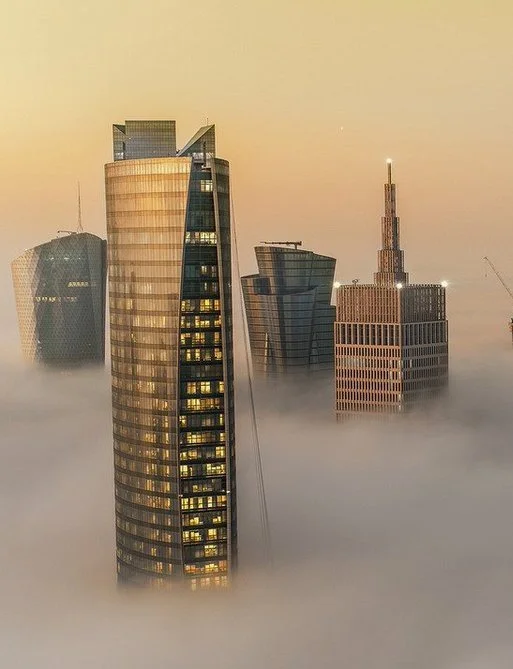
How Air Leakage Drives Up Cooling Costs in Qatar?
Cooling accounts for 60–70% of total electricity use in many Qatari buildings, according to regional energy studies and benchmarks. With long periods of extreme heat and high humidity, even small leaks in a building’s envelope significantly increase cooling demand. Many building owners assume high cooling bills stem only from weather or HVAC performance, but a major hidden factor is air leakage.
Air leakage occurs when hot, humid outdoor air enters and conditioned air escapes through gaps in the façade. These gaps commonly form around window frames, door seals, façade joints, duct connections, and mechanical/electrical penetrations. In Qatar’s climate—where summer temperatures routinely exceed 45°C and humidity can reach 80–90%—even minor leakage forces HVAC systems to work much harder.
When infiltration occurs, AC systems must remove both heat and moisture. Moisture removal alone can account for 30–40% of cooling energy, especially in Doha’s coastal environment. Studies in Gulf high-rise buildings show that:
A 10% increase in air leakage can raise cooling costs by 20–30%.
Overcooling in Qatari office towers results in ~27% wasted cooling energy due to unnecessary HVAC runtime.
Poor façade sealing and glazing performance can increase cooling loads by 25–35% in typical Gulf high-rises.
This wasted load accumulates daily—raising electricity bills and reducing HVAC lifespan.
High-rise towers in West Bay, Lusail, and The Pearl face additional challenges such as wind pressure, stack effect, and large glazed surfaces, making airtightness even more critical.
Thermal Imaging: The Fastest Way to Detect Leaks in Qatar’s Towers
Traditional inspections often miss micro-gaps or hidden façade defects. Thermal imaging, however, reveals them instantly by visualizing abnormal temperature patterns. This technology is now essential for efficient building diagnostics in Qatar.
For high-rise buildings, drone-mounted thermal cameras enable full-façade scanning—reaching areas impossible to inspect manually. AI software automatically detects leakage, pinpoints locations, and generates reports showing estimated energy losses, financial impact, and potential CO₂ savings.
Thermal imaging detects:
Air leakage around windows, curtain walls, and expansion joints
Poor sealing and insulation failures
Structural cracks allowing heat infiltration
Delaminated panels and moisture-intrusion zones
HVAC duct leakage inside shafts and ceilings
Airtightness and Qatar’s Sustainability
Qatar’s sustainability programs, national energy-efficiency frameworks, and municipal building guidelines—emphasize performance, not just design. Air leakage control directly supports:
Lower energy consumption
Reduced carbon footprint
Improved indoor comfort
Longer HVAC lifespan
As Qatar moves toward smarter, more efficient infrastructure, thermal imaging and airtightness verification are becoming core requirements for responsible building management.
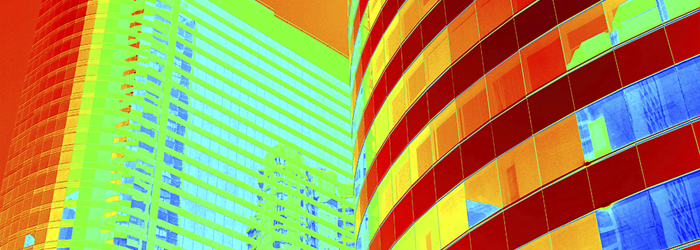
Drone systems deliver superior safety, faster operation, reduced resource consumption, and measurable energy-efficiency benefits.